A hybrid model can need two different kinds of state to resume a prefix: recurrent state at a valid boundary, and the attention history that boundary depends on. Moving one buffer successfully is useful evidence. It is not yet evidence that a model resumed correctly.
AIBrix Hybrid KV Cache investigates that gap through an independent experimental extension of AIBrix. The useful starting point is small: store variable-sized records, preserve readers during eviction, and account for the bytes actually stored. A CPU example makes those contracts inspectable without downloading a model or provisioning GPUs.
Why a prefix is more than an attention buffer
vLLM’s hybrid cache design describes cache management across different attention/state requirements. For this project’s hybrid connector, a reusable boundary combines recurrent state with a chain of incremental full-attention spans. Both must belong to the requested record identity. Every required tensor-parallel rank must report its required parts before the scheduler advertises that boundary as available.
This is a property of the experimental connector, not a claim that ordinary KV offloading is universally incorrect or that every hybrid architecture has the same layout. The implementation and its engine/model versions matter.
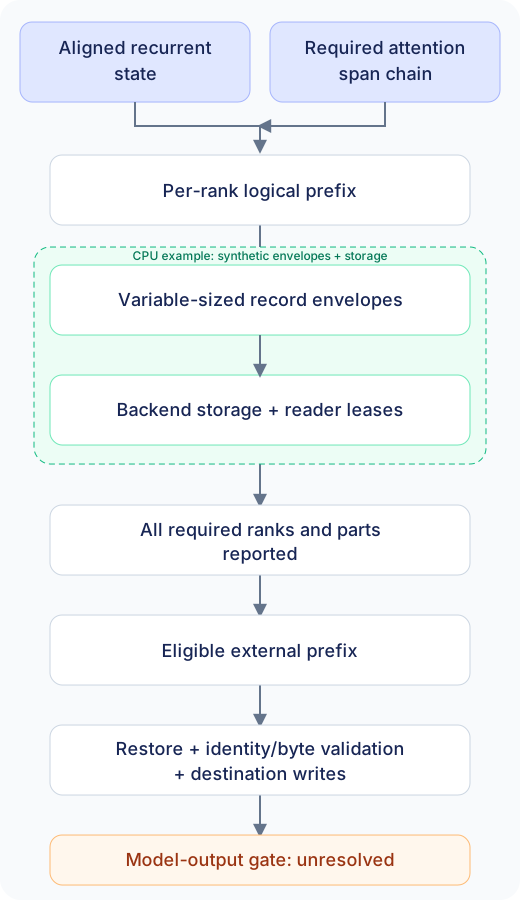
A byte-store example exercises the middle of this diagram. It does not run the scheduler, establish rank completeness, or demonstrate the final model gate.
The first upstream contribution is a byte-store contract
PR #3221 proposes an optional
variable_payload capability, get_bytes/put_bytes, and a bounded MEMORY
backend. Backends without the capability retain their existing contract.
The full connector, codecs and profiler remain downstream.
The backend’s capacity counts stored payload bytes. Reads update LRU order; eviction skips leased entries. Admission first finds enough eligible capacity, then evicts the selected batch. If admission cannot succeed, the existing records remain intact. A duplicate key with identical bytes is idempotent; different bytes under that key are rejected.
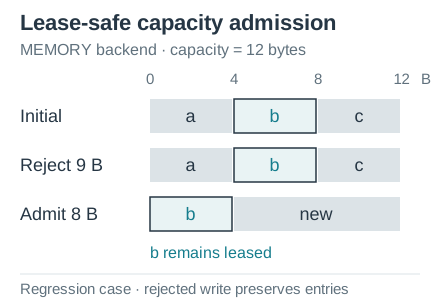
A lease also protects against deletion and close. Typed/shaped memoryviews count their byte length rather than their first dimension. Contiguous read-only views can be borrowed under an explicit backing-buffer ownership contract; read-only does not mean the underlying owner can never mutate the buffer. Writable or strided inputs are copied.
MEMORY is process-local and volatile. Its byte capacity excludes Python objects, allocator overhead and transient staging buffers. A 10 GiB setting is neither a 10 GiB total process-memory limit nor a distributed cache.
Run a small example before running a model
Use Linux or macOS with Python 3.11/3.12 and the existing package dependencies. No GPU, vLLM server, Redis server, Kubernetes cluster, model weights or request credentials are needed. Torch is an existing import dependency even on CPU.
git clone --branch cpu-quickstart-v1 --depth 1 \
  https://github.com/mynotwo/aibrix-hybrid-kvcache.git
cd aibrix-hybrid-kvcache
python3.12 -m venv .venv
. .venv/bin/activate
python -m pip install -r python/aibrix_kvcache/requirements/core.txt
PYTHONPATH=python/aibrix_kvcache python -m tools.cpu_quickstart \
  --output work/cpu-demo-1
The full quickstart includes platform requirements, expected output, regression commands and troubleshooting. The pinned tag identifies the example; it does not announce model or production support.
The script sends two synthetic byte vectors through the real connector:
4,096 bytes named state and 8,192 bytes named span. Their names do not
make them valid hybrid tensors. Each arm encodes, stores, retrieves, decodes
and checks every byte. Separate checks exercise duplicate writes, protected
admission, safe rejection, close during a lease and subsequent eviction.
It also rejects a wrong generation and a corrupted checksum for each record.
Count the envelope, not just the compressed payload
These are observations from macOS arm64, Python 3.12.13, Torch 2.14.1 and zstandard 0.25.0, using deliberately repetitive synthetic input:
| Arm | Raw bytes | Encoded payload | Metadata | Framing | Full stored bytes |
|---|---|---|---|---|---|
| IDENTITY | 12,288 | 12,288 | 524 | 24 | 12,836 |
| CPU zstd | 12,288 | 301 | 513 | 24 | 838 |
For both rows, payload + metadata + framing equals full stored bytes.
IDENTITY grows because it still carries a self-describing envelope. A tiny
payload can compress well while its metadata becomes most of the stored
object. Comparing raw bytes only with the compressed payload would hide that
cost. The summary’s raw_to_envelope_ratio uses full stored bytes as its
denominator.
The published JSON evidence contains the summary, all 16 JSONL-derived event records, dependency versions and the demo source SHA-256. There are eight measured events per arm: four stages for each of two records. The real recorder’s run validity, dependency structure and zero-drop status are checked. A nonzero exit signals a failed invariant.
This trace is explicit instrumentation of the example’s CPU operations. It is not a complete serving trace or an automatic observation of every inference stage. Absolute monotonic timestamps are local to the recorded run.
Stored-byte savings are not a latency result
This example’s zstd encoder and decoder run on the CPU. It does not show compressed bytes traversing PCIe. The experimental GPU path uses a separate, optional ANS record codec; its codec placement and transfer behavior need their own measurements.
For a path that really transfers S_wire bytes at effective bandwidth B,
transfer time is bounded below by S_wire / B. Stored-object size is not a
substitute for S_wire. Encoding, decoding, destination writes, waiting and
remaining model computation can dominate the request. Overlapping stages must
be evaluated on the actual timeline rather than added as if they were serial.
For a required multi-rank restore, the request cannot finish before its slowest
required rank is ready.
The binding question is therefore whether saved critical-path transfer work exceeds added codec and staging work after all dependencies are respected. A smaller stored object alone cannot answer it. This article makes no TTFT, throughput or end-to-end speedup claim.
Byte equality has not settled model correctness
The model investigation
records both passing and failing trials under the same strict acceptance gate.
At source a00a2620, an IDENTITY trial passed, a repeat failed, and an ANS trial
passed. Per-rank byte verification and destination readback matched for the
required state/span parts in all three trials. The failing repeat still failed
whole-model output acceptance. The
sanitized model evidence
is public; private model inputs and raw request logs are not.
A connector-disabled control also observed output variability, but its output variants did not explain the failing connector trial. That is a reason to investigate matched baselines, not a reason to excuse the failure. The cause remains unresolved. Passing individual runs and record checks do not establish stable whole-model equivalence, and the acceptance criterion has not been relaxed to turn the failure into a pass.
A reviewable path upstream
The RFC covers the broader design. The first PR stays limited to the optional byte API and MEMORY backend. It remains a Draft for interface feedback; upstream execution also depends on maintainer workflow approval. Public downstream CI evidence is linked from the PR, with its exact source version rather than an implied result for all future changes.
Useful first feedback is concrete: can a consumer use the optional byte API without changing fixed-block backends; do lease and duplicate-key semantics fit the existing connector interface; and does the byte-capacity contract make memory accounting clear enough? A reproduction report should include the source revision, platform/dependency versions, exact command, nonzero exit or observed invariant failure, and public synthetic artifacts where possible.
The CPU example supports evaluation of the byte-storage contract. Broader model compatibility and serving-performance claims require additional evidence.
Comments